“If you think beavers are only good for building dams… think again. They now manage maple groves.”
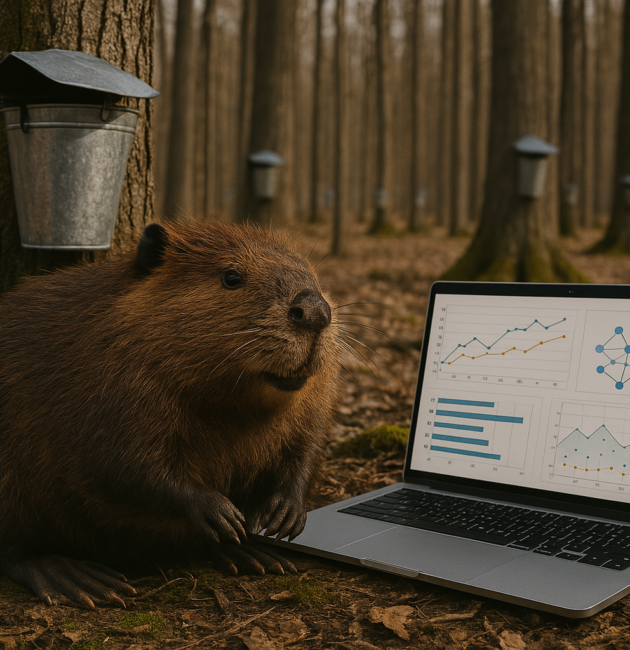
In the woods of Cookshire-Eaton, Eastern Townships, a surreal scene plays out beneath ancient maple trees: a beaver named Gaston, wearing a connected harness, climbs a tree and delicately inserts a tiny tap into the bark. Nearby, a drone hums: “Good job, buddy. Here’s your reward,” before launching a frozen poutine bite into the air.
Welcome to Project MapleAI, where artificial intelligence, robotics, and rodent engineering join forces to revolutionize… maple syrup production.
The Idea: Replace Sugar Bushes with “Beaver Bushes”
It all started with a shortage. In 2024, Quebec produced 72% of the world’s maple syrup but struggled to tap 50 million trees due to labor shortages.
“Young people don’t want to work in the forest at -20°C anymore,” says Jean-Philippe Morin, a fourth-generation maple farmer. “Innovate or die.”
Enter MapleAI, founded by two former Bombardier engineers and a beaver-loving biologist. Their idea? Train beavers to tap maple trees, guided by drones and rewarded with low-grade Canadian junk food.
“Beavers are already natural engineers,” argues cofounder Élodie Beaupré. “Why not teach them to tap trees instead of cutting them down?”
The Process: Drones, Poutine & Neurochips
Here’s how MapleAI operates:
- Beaver recruitment: Humanely trapped in areas where they pose risks to infrastructure. “We offer them a deal: job, housing, all-you-can-eat buffet,” laughs Élodie.
- Training: Beavers learn to recognize maples from firs via giant touchscreens (rewarded with Cheez Whiz).
- Gear: GPS harness, mini headset for voice commands (“No, Gaston, that’s a birch, tabarnak!”), and sap sensors.
- Supervisor drones: Monitor progress, correct mistakes, and deliver rewards (poutine, Timbits, or syrup for the high performers).
“The real challenge is stopping them from drinking the sap,” admits a technician. “We lost 10% of the 2024 harvest to a beaver rave in the tubing system.”
The Results: 30% More Sap… and Unionized Beavers
The first results from 2025 are promising:
- 30% increase in sap yield, thanks to cleaner taps and less tree damage.
- Lower costs: a beaver costs 2 poutines/day vs. $25/hr for a human worker.
- Green bonus: their dams help regulate water flow in the groves.
But it’s not all smooth sailing. In August 2025, a “strike” broke out when MapleAI tried to reduce cheese curd rations.
“The beavers clogged the lines with branches,” sighs Élodie. “We negotiated peace with double portions.”
Backlash: Traditional Producers Cry Heresy
In Saint-Georges-de-Beauce, purists are furious.
“It’s an insult to our ancestors!” fumes Marcel Lapointe, head of the Producers’ Federation. “Maple syrup is sacred, not a Disney ride with DJ beavers!”
Others fear slippery slopes:
- Tech dependency: “If the drone breaks, the beavers are clueless,” says one blogger.
- Surveillance: Concerns over GPS tracking the animals.
- Animal ethics: “Are we exploiting beavers?” asks one NGO. MapleAI replies, “They’re free to leave… but they stay for the poutine.”
What’s Next: Beaver Influencers and Cirque du Soleil
MapleAI isn’t stopping there:
- Beaver influencers: TikTok account @GastonTheBeaver already has 500k followers. Next step? A duet with Céline Dion.
- Expansion: Training beavers to harvest hickory nuts… and fight climate change.
- Showtime: A Cirque du Soleil collab featuring “Flying Beavers” (with safety nets, of course).
“We dream of replacing all tractors with beavers by 2030,” says Élodie. “Canada will be the world’s first rodent-powered nation.”
Conclusion: When Tradition Meets Absurdity (and Poutine)
MapleAI perfectly embodies Canadian spirit: bold, ridiculous, and full of “Why not?” despite -30°C weather.
Is it viable? Maybe not. But as Gaston the beaver (via AI translation) puts it:
“I used to break bridges. Now I make syrup. That’s evolution, eh.”
Ready to try beaver-certified syrup? Coming in 2026… if the union signs.