
By Marc-André Tremblay, tech correspondent in Montreal
“You know, when your AI gets that ‘prendre une marche’ is more chill than ‘going for a jog’…”
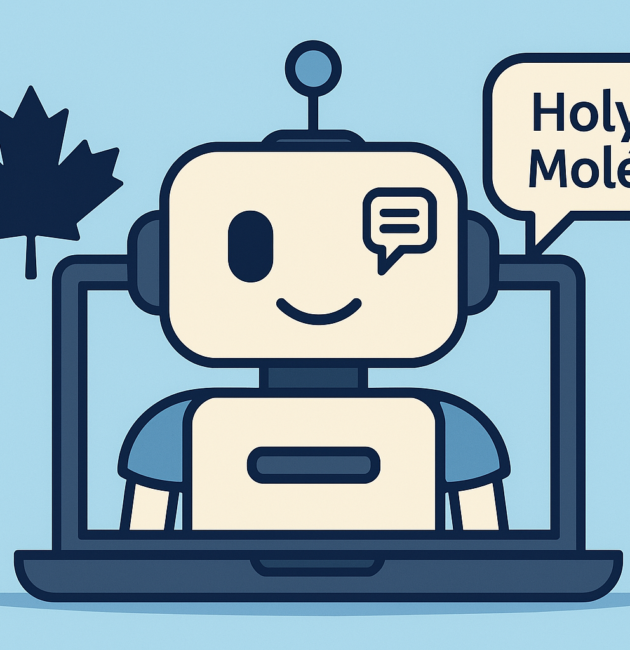
Imagine an artificial intelligence that replies to you in French… but casually drops a “no worries” when you mention your morning stress. An AI that, upon detecting your Franco-Ontarian accent, adjusts its tone to offer a comforting “Ça va bien aller, là.” Welcome to the world of GPT-6, the first AI built in Canada—not just fluent in Franglais, but immersed in it.
This morning, in the offices of NovaTech in Quebec City, I got to test this technological gem. After typing, “J’ai un date ce soir, mais chu en panique totale. Help?”, GPT-6 answered: “Ok, take a deep breath. Tu vas slay, trust me. And if it doesn’t click, we’ll grab a 5@7 to debrief.”
You guessed it—this AI is not your average chatbot.

Why Canada Was the Perfect Breeding Ground for This Revolution
Canada, land of linguistic compromise, poutine, and excessive politeness, seemed destined to create a bilingual, culturally nuanced AI.
“We wanted a tech that reflects our identity,” explains Élodie Chen, project lead at NovaTech. “Here, we switch from ‘Bonjour-Hi’ to ‘Sorry’ in half a second. GPT-6 had to catch that.”
Unlike American models designed for an overwhelmingly English-speaking market, GPT-6 was trained on uniquely Canadian datasets:
- 40% from transcripts of bilingual family arguments (yes, the ones where Uncle Robert flips from “Tabarnak” to “Oh my god” depending on his mood).
- 25% from memes on the “Québec vs The Rest of Canada” page.
- 15% from federal political speeches (to master the art of not answering questions).
- 20% from bar conversations in Montreal, Toronto, and Vancouver (including classic post-2 a.m. lines like “Hey, wanna split a poutine?”).

Cultural Subtext Decoding: The Holy Grail
GPT-6’s real magic? Decoding the unspoken. A test with users in Winnipeg showed that the AI correctly interpreted nuanced phrases like:
- “Il fait froid, hein?” → Translation: “Close the door, I didn’t heat the cabin for fun.”
- “We should grab a Tims” → “I need caffeine and small talk to survive today.”
- “That’s… special” → “It’s awful, but I’m too polite to say it.”
“Canadians use tons of euphemisms and passive sarcasm,” notes linguist Jean-François Dubois. “A basic AI might think ‘Pas pire pantoute’ is a lukewarm review. GPT-6 knows it means, ‘It’s amazing, I’m just playing it cool so I don’t seem arrogant.’”

The Franglais Challenge: When “Ça Fait du Bien” Meets “Holy Fudge”
Mixing French and English may seem easy, but NovaTech’s team faced some wild linguistic puzzles:
- Quebec swearing vs prim English: GPT-6 knows “esti de calvaire” isn’t an insult—it’s a response to a Microsoft Tech Support call. It also automatically replaces “Holy Sh*t” with “Holy Molé” if the user is over 65 (thanks, politeness settings).
- Regional quirks: In Vancouver, “Loonie” means the $1 coin. In Toronto, it can also mean “That guy’s a bit nuts.”
- Hybrid expressions: “Ça feelait weird en esti” = “I was uncomfortable, but not enough to bring it up.”
To fine-tune this, developers ran focus groups in CEGEPs and Irish pubs.
“We spent a week watching McGill students switch languages while ordering beer,” laughs Élodie. “Now GPT-6 knows that ‘Criss, I have an exam tomorrow’ deserves more empathy than just ‘Damn, I have a test.’”
Real-World Applications: From Low-Cost Therapy to Customer Service at Canadian Tire
GPT-6 isn’t just a toy for bilingual millennials. Its surprising use cases include:
- Franglais Therapy: Clinics in Alberta now offer sessions with GPT-6 for patients too shy to discuss stress in either English or French. One user shares: “It’s less intimidating to say ‘J’ai du trouble à breath’ than ‘I have breathing problems.’”
- Customer Service: At Canadian Tire, the AI handles complaints with signature Canadian tact. A real example: “Your snowblower wrecked my driveway” → Response: “We’ll send a buddy over with a new part, no worries.”
- Education: At the University of Ottawa, translation students use GPT-6 to grasp untranslatable subtleties (“How do you translate ‘spleen’ without losing its melancholic vibe?”).
Controversies: Did Canada Sell Its Soul to AI?
Not everyone’s a fan. In Sherbrooke, a French-language purist group protested in front of NovaTech’s offices with signs like “Franglais Non Merci.”
“It’s an insult to Molière!” fumed the group’s president.
Worse, some users reported cultural misfires.
“I asked for a tourtière recipe, and GPT-6 gave me ‘poutine sushi’… That’s criminal!” raged a user from Trois-Rivières.
NovaTech’s team assures us: “We implemented filters to block culinary atrocities. ‘Poutine sushi’ is officially blacklisted.”
What’s Next? “We Want It to Learn Inuktitut”
Next up: Indigenous languages.
“GPT-6 already gets joual and chiac. Why not Cree or Anishinaabe?” dreams Élodie. It’s a big challenge—but key for an AI claiming to be 100% Canadian.
Meanwhile, NovaTech’s servers are on fire with requests. Between teens asking GPT-6 to write their texts (“Translate ‘I miss you’ but make it extra cheesy”) and small businesses wanting bilingual slogans (“Votre dépanneur, open 24/7 with love”), the AI has found its place in the local tech scene.
An AI as Canadian as Maple Syrup
GPT-6 represents the best of Canada: blending opposites with a touch of self-deprecating humor. It’s not perfect, but as its creators say:
“C’est pas pire pantoute, tsé.”
Want to try it? Head to NovaTech.ca and ask: “What’s the secret to happiness?”
Its favorite answer: “A combo of poutine, hockey, and saying ‘Sorry’ even when it’s not your fault.”

Liked this article? Share it with your franglais-speaking work buddy… or your grandma who hates it.