
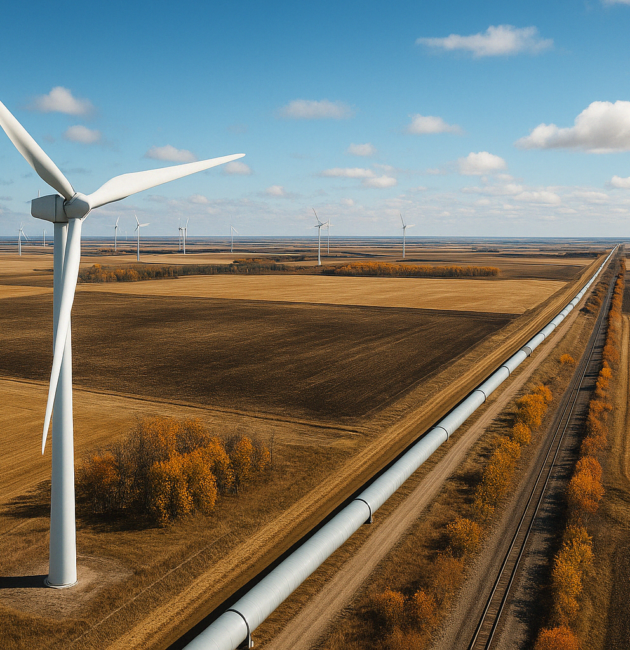
Faced with energy challenges and growing trade tensions with the United States, Canada is considering a bold initiative: the creation of a National Energy Corridor linking Alberta to Ontario. The goal of this corridor is to facilitate the transport of clean energy across the country, notably electricity generated by Alberta’s wind farms. However, the initiative has sparked heated debate—particularly in Quebec, which sees it as a threat to its longstanding leadership in Canada’s energy sector.
Background: A National Energy Shift
Donald Trump’s re-election in 2024 triggered a significant overhaul of Canada-U.S. trade relations. Canadian Prime Minister Mark Carney declared that the country’s traditional economic relationship with the U.S. was “over,” announcing the removal of internal trade barriers within Canada by July 1, 2025. The aim? Strengthening east-west economic integration within Canada, with a focus on clean energy—particularly electricity, nuclear, wind, and solar. (Source: Politico)
In this context, Conservative Party leader Pierre Poilievre proposed the creation of a National Energy Corridor. This pre-approved corridor would fast-track the deployment of infrastructure such as pipelines, transmission lines, and railways, optimizing the distribution of clean energy across provinces. (Source: L’Actualité)
Alberta: A Wind Energy Giant on the Rise
Long known for its oil and gas, Alberta is now rapidly expanding into renewable energy, particularly wind. The Buffalo Plains Wind Farm, near the town of Lomond, is emblematic of this shift. With a planned capacity of 495 MW spread across 83 turbines, it’s set to become the largest onshore wind project built in a single phase in Canada. The project is expected to power approximately 240,000 homes and reduce CO₂ emissions by nearly 795,000 tonnes per year. (Sources: EBMag, Power Technology)
At the same time, global companies are pouring money into Alberta’s clean energy sector. TotalEnergies, for instance, recently acquired nearly one gigawatt of wind and solar projects in the province—boosting Canada’s renewable capacity even further.
Quebec: Concerns, But Also Opportunities
Quebec, a historical leader in hydroelectric power, is viewing the corridor project with skepticism. The province worries that such an initiative could divert investment away from its own energy projects and undermine its dominant role in Canada’s clean energy ecosystem.
That said, some experts argue the corridor could benefit Quebec as well. Philippe Dunsky, head of a Montreal-based consulting firm, points out that better east-west integration could help optimize the national energy system and lower costs for Canadians. He advocates for joint planning that transcends current provincial silos.
Challenges of the National Energy Corridor
Building a project of this scale comes with serious challenges. Environmental concerns top the list—particularly when it comes to routing infrastructure through ecologically sensitive areas or Indigenous lands. Thorough consultation and rigorous impact assessments will be crucial to achieving social license for the project.
Interprovincial collaboration is another key factor. While Alberta and Ontario appear supportive, Quebec is expressing clear reservations. The success of this initiative will depend on balancing the priorities and interests of each province.
Toward Stronger Interprovincial Collaboration?
For the project to move forward, close collaboration between provinces is essential. Dunsky once again emphasizes the importance of east-west regional integration to improve the energy system and reduce costs for consumers. He calls for a collaborative planning effort that overcomes current interprovincial barriers.
Alberta’s Minister of Transportation and Economic Corridors, Devin Dreeshen, has also voiced strong support for the project, noting that Alberta has long advocated for a national-level approach to energy infrastructure. (Source: CityNews Edmonton)
An Ambitious, Multi-Faceted Project
The national energy corridor linking Alberta to Ontario represents Canada’s drive to strengthen energy independence and embrace renewable sources. However, its success will depend on whether provinces can set aside differences and work toward a shared vision—one that puts national interest first. The challenge is substantial, but so is the potential payoff for Canada’s energy future.